In recent years, AI has evolved from primarily technical applications to accessible 'conversational AI' used daily by many people. Chatbots are increasingly deployed as tools for brainstorming, text processing, and answering questions - both professionally and privately.
Where AI was previously mainly used for data processing and specialized tasks, we now see a shift towards more natural, interactive applications. Major tech companies are investing heavily in this development. OpenAI is improving their chatbots' conversational abilities, Google is working on more intuitive AI assistants, Meta is experimenting with various AI personas, Apple is expanding Siri's capabilities, and Microsoft is increasingly integrating AI assistants into all their products.
In this shift, AI is no longer just about efficiency, but also about proximity and relationship. People are increasingly having conversations with systems that need to be more than a tool – they need to feel like a companion: a buddy that's always available, that listens, remembers, and responds.
For healthcare and welfare, this opens up a world of possibilities. AI companions can support the elderly, guide patients, and relieve healthcare professionals. But the question is: how do we know if that technology is actually meaningful?
Beyond the Turing Test
Until now, intelligence has often been measured using the famous Turing test. Mathematician and computer pioneer Alan Turing posed the question in 1950: can a machine behave in such a way that a human can no longer tell they're talking to a computer? That benchmark has its historical value, but in healthcare and welfare it may sometimes fall short.
The point here isn't whether a robot seems human, but whether this humanity is meaningful. An AI that's perfectly capable of 'small talk' but offers no support has little value. A simple digital assistant that does help with medication reminders or stress reduction can, on the other hand, be of invaluable significance.
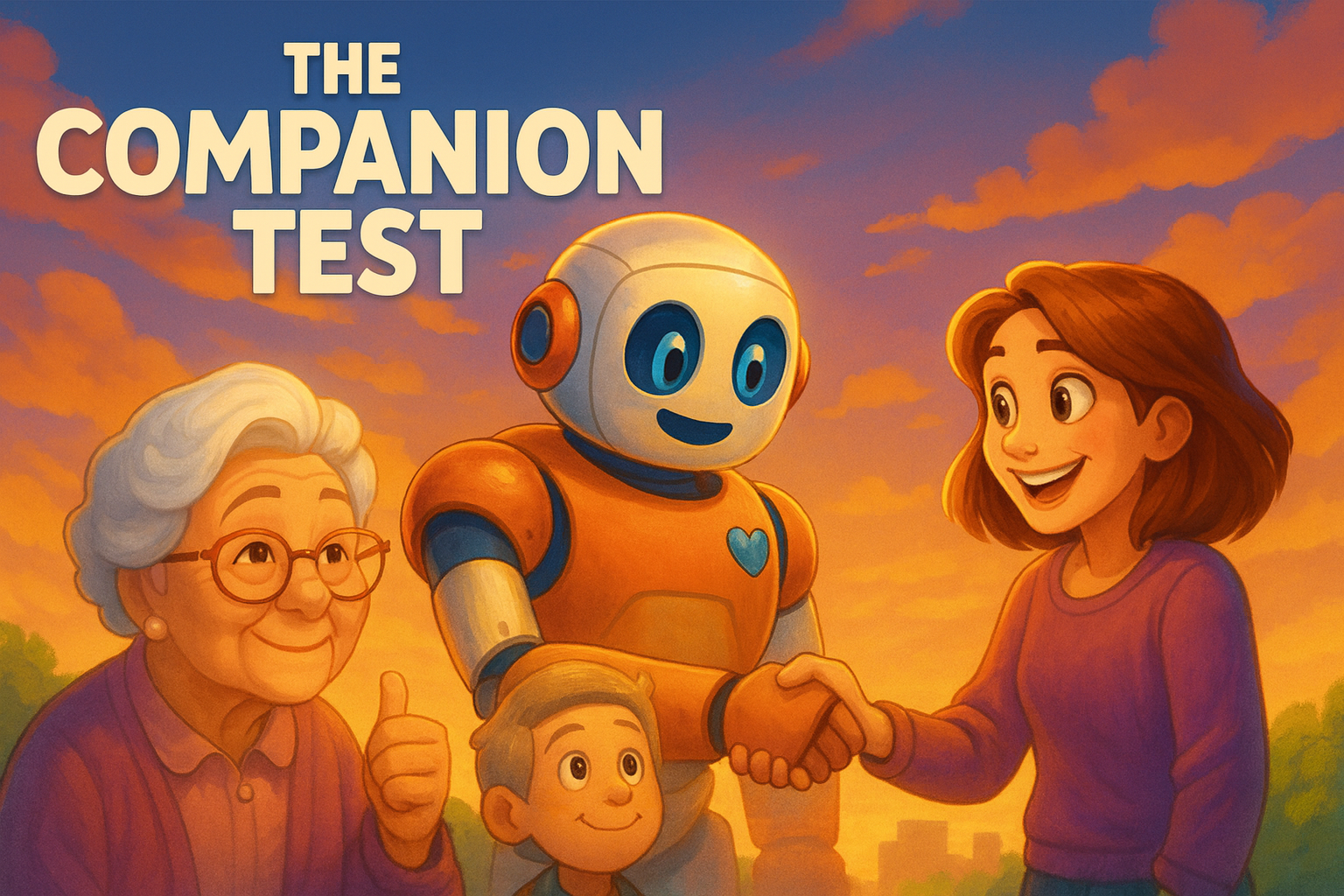
That's why I propose a new assessment framework: The Companion Test. Inspired by The Mom Test by Rob Fitzpatrick, where entrepreneurs learn to ask better questions. Not: "Would you use this?" but: "How do you use this now?" Because only behavior shows what truly has value. The same applies to AI: it's not the promise or appearance that counts, but the proof in daily use.
Companion Test as Compass
The companion test is more than a checklist. It's a compass that provides direction on how to responsibly deploy AI companions and social robots in healthcare and welfare. Technology develops at lightning speed, but without direction we can also simply lose our way completely.
A compass always points north, but also helps us be aware of other directions. This is how the companion test shows which course we should follow, what opportunities present themselves, which pitfalls we should avoid, and where the boundaries lie.
North – Direction
Human-centered value
The north of the compass points to the core question: does the AI or robot contribute to daily life, wellbeing, and autonomy of people? Only when technology becomes visibly integrated into the routines of clients, patients, and healthcare professionals, is there true significance.
East – Opportunities
Innovation and possibilities
The east represents the opportunities that present themselves. Here we look at innovations that strengthen healthcare and welfare. Think of AI that safely supports medication use, digital companions that reduce stress, or robots that relieve caregivers with simple tasks. This is the domain of hopeful applications – provided they're actually used.
South – Dangers
Avoiding pitfalls
The south reminds us of which pitfalls we should avoid. AI companions that create dependency, give wrong advice, or imperceptibly make users passive can cause harm. Big Tech's influence also belongs here: as AI companions become more intimate parts of our social lives, we must be extra alert to risks for autonomy and wellbeing.
West – Boundaries
Frameworks and markers
The west of the compass marks the necessary boundaries. Here lie the markers of safety, reliability, and transparency. Only when users trust the technology can it contribute sustainably.
Concrete Questions
Based on this compass, the companion test translates into six concrete questions:
-
1
Does the companion really matter in daily life? Does the AI naturally become part of routines, or does it remain a gimmick?
-
2
Does the companion show genuine interest and memory? Does the AI remember details important to the relationship, or does it remain superficial?
-
3
Is the companion safe and reliable? Does the AI provide advice and support without risk of harm, especially for vulnerable users?
-
4
Does the companion adapt to emotions and context? Can the AI respond to mood and timing, instead of only giving neutral answers?
-
5
Does the companion increase autonomy, or create dependency? Does the AI stimulate personal control, or does it imperceptibly take over control?
-
6
Does the companion maintain value over time? Is the technology still relevant and meaningful after six months or a year?
Impact of Big Tech
What makes this all extra urgent is that Big Tech is increasingly integrating AI companionship into our lives. Chatbots and avatars are positioned as friends, coaches, or confidants. This can offer opportunities – from low-threshold support for loneliness to guidance with stress.
But if these companions don't pass the test, it can lead to loss of autonomy, impoverishment of relationships, and reduced resilience in society. That's precisely why not only healthcare institutions, but also technology companies must be held accountable for their social responsibility. AI companions aren't toys, but technology that penetrates deeply into our personal lives.
Significance for Healthcare and Welfare
The companion test helps healthcare and welfare to set the right course in a complex landscape:
- Healthcare organizations can use the test as a selection framework for innovations.
- Policymakers can link investments and subsidies to this assessment.
- Healthcare professionals get guidance to critically evaluate which AI strengthens their work.
- Clients and patients can better assess whether a companion truly supports them.
For example, it may be that a simple medication assistant scores higher on the companion test than an advanced robot that mainly looks cool. Or that a virtual companion for mental health only proves valuable if it can adequately recognize and support emotions.
Staying on Course with the Compass
AI companionship isn't a distant future, but a reality developing rapidly: right before our eyes. For healthcare and welfare, there are unprecedented opportunities, provided we don't blindly embrace technology and carefully assess it. The companion test provides a compass for this. North gives direction toward human-centered value, east opens the view to opportunities, south warns of dangers, and west guards the boundaries. With six practical questions, we can stay on course in a rapidly changing landscape.
The call is clear: use the companion test as a navigation instrument for social robots and AI in healthcare and welfare. This way we don't build dependency or alienation, but technology that truly makes us stronger and more resilient. And where we ourselves (I like to repeat) remain in control of how this new 'friendship' develops and forms.
The Compass in Our Hands
A compass only works if you use it. The companion test now lies before you – not as a theoretical instrument, but as a practical guide for choices we make today. We stand at a reflective crossroads. Left lies the path to smart toys that impress but mean little. Right lies the route to technology that truly serves. AI companionship promises much, but promises are cheap and technology is expensive.
The question isn't whether AI companions are coming – they're already here. The question is whether we determine the course, or whether the course determines us. And we make that choice now, with every robot we allow and every AI we embrace. The best AI companions aren't those that replace us, but those that help us be more ourselves. We only deserve true companions when they pass the test of time – and that begins today.
Do you follow the compass? 🧭